Planning 18/20 Production 46/60 Evaluation 16/20 Overall 80/100 Grade A
Tuesday, 9 December 2008

Wednesday, 26 November 2008
Film I produced and Evaluation
This is my media project film, the following footage was recorded by myself and edited using iMovie on the Apple Macs which are provided at the Media Department. I used a number of different techniques when filming my short film, they were:
Evaluation:
In what ways does your media product use, develop or challenge forms and conventions of real media products?
My media video challenges real life media videos as it uses many of the professional camera shots and cutting that real life editors and producers would use (as well as the iMovie program which many top class directors use when creating high cost movies). I found the majority of camera shots very straight forward to capture as i studied many top quality films, such as THE MATRIX and THE DARK KNIGHT which constantly use the likes of 180 degree rule, shot/reverse shot and two shot etc. I also believe that because i researched the topic in great detail it gave me more confidence to experiment on different angles which i might not of been able to achieve without the research I put in before creating the movie.
How does your media product represent particular social groups?
Because my film is based about a student who has clearly underachieved in their particular subject and has been summoned to the head of sixth form's office to have a conversation bout it and sort it out shows that the two main social groups would likely to be students at secondary school and also the teaches who work at schools. I say students because I believe that many students would have either had a similar experience before hand or will be likely to experience it in the future. And the teachers may also fit into the social group as it can teach them sometimes how to deal with students who are not for filling their undoubted potential or are just plain lazy. Or so teaches are normally stereotyped as very disciplined and strict and my teacher for fills all of those characteristics. Almost like a parental figure.
What kind of media institution might distribute your media product and why?
The only real media institution that would consider distributing my media film would be either the media department of a college so that they could use it as an example (either a good example or a rather poor example) of all the criteria that is required in the project and it could also help explain particular shots and angles that are hard to explain without a good example. it would also work as it is based in a school classroom and in a similar environment that the students are working in to complete their product. It would also be a good example to schools as it is quite a serious issue having students who are clearly not putting effort into their work and it could help show lazy students that it is not cool to slack behind in lesson time when other students are trying to complete their work.
Who would be the audience for your media product?
As i have already said above, the main audience for my media video project would have to be students at a school, along with the teaches working with the students. This is because the entire film is based in a school classroom and involves a lazy student and a strict teacher who wants to understand why the student to failing in the media subject. it would help students understand the problem with students who do not put enough effort into any particular school subject and the issues that it can cause with teaches, as well as the stress it can put on teachers at the same time. It also helps teachers understand that every student is different and has different learning abilities and qualities.
How did you attract/address your audience?
To attract my audience i stationed my movie in a classroom at Victoria College so that the students and teachers would automatically know exactly where is was based so they could easily relate to it. I feel that I addressed my audience by just generally basing it in school the students and teachers could easily relate to them. Also I used Morris as the actor because he is a well respected actor in the year and is generally a funny guy. I used the dialogue in it so that each student would understand exactly what the situation is and how it might effect individuals if they were in that situation. Also I believe that even though my video has no obvious humor, the distinct and suttle humor in it makes it very funny at certain points.
What have you learnt about technologies from the process of constructing this product?
I have learnt how to operate iMovie, so much so that I am now 100% sure that I can use it for almost any filming editing as it is so straight forward to use and understand compared to other editing programs available over the net. i have also used how to film different camera shots and angles for different situations. A good example is match on action, when i want to show the importance and significance of the student opening the door I was able to shoot one take on him opening the door and the other shot was a zoomed in shot on his hand opening the door. Also when using iMovie I learnt how to edit and cut different parts of the footage which is not required and when it is required i learnt that it needs to be in timing with the other footage to make sense. Overall I have learnt more in this practical than any before as I found it more interesting the the program was highly acceptable to use and Mr. Winn explained the basics of understanding the program which also greatly helped when I needed to add certain affects to the video. A great experience!
- Match on action- When Micheal Morris was opening the door it cuts just as he was opening it and zoomed in on his hand.
- Shot\Reverse shot- when Lawrence and Micheal are having the conversation, when Lawrence talks the camera is focusing on Morris and Visa verse.
- Over the shoulder shot- shot taken from behind both of my characters shoulders when they are speaking.
- Two shot- when they first begin talking , the shot of them when both Lawrence and Michael are in the shot talking.
- 180 degree rule was kept in tact whilst both characters where once again talking to each other.
Evaluation:
In what ways does your media product use, develop or challenge forms and conventions of real media products?
My media video challenges real life media videos as it uses many of the professional camera shots and cutting that real life editors and producers would use (as well as the iMovie program which many top class directors use when creating high cost movies). I found the majority of camera shots very straight forward to capture as i studied many top quality films, such as THE MATRIX and THE DARK KNIGHT which constantly use the likes of 180 degree rule, shot/reverse shot and two shot etc. I also believe that because i researched the topic in great detail it gave me more confidence to experiment on different angles which i might not of been able to achieve without the research I put in before creating the movie.
How does your media product represent particular social groups?
Because my film is based about a student who has clearly underachieved in their particular subject and has been summoned to the head of sixth form's office to have a conversation bout it and sort it out shows that the two main social groups would likely to be students at secondary school and also the teaches who work at schools. I say students because I believe that many students would have either had a similar experience before hand or will be likely to experience it in the future. And the teachers may also fit into the social group as it can teach them sometimes how to deal with students who are not for filling their undoubted potential or are just plain lazy. Or so teaches are normally stereotyped as very disciplined and strict and my teacher for fills all of those characteristics. Almost like a parental figure.
What kind of media institution might distribute your media product and why?
The only real media institution that would consider distributing my media film would be either the media department of a college so that they could use it as an example (either a good example or a rather poor example) of all the criteria that is required in the project and it could also help explain particular shots and angles that are hard to explain without a good example. it would also work as it is based in a school classroom and in a similar environment that the students are working in to complete their product. It would also be a good example to schools as it is quite a serious issue having students who are clearly not putting effort into their work and it could help show lazy students that it is not cool to slack behind in lesson time when other students are trying to complete their work.
Who would be the audience for your media product?
As i have already said above, the main audience for my media video project would have to be students at a school, along with the teaches working with the students. This is because the entire film is based in a school classroom and involves a lazy student and a strict teacher who wants to understand why the student to failing in the media subject. it would help students understand the problem with students who do not put enough effort into any particular school subject and the issues that it can cause with teaches, as well as the stress it can put on teachers at the same time. It also helps teachers understand that every student is different and has different learning abilities and qualities.
How did you attract/address your audience?
To attract my audience i stationed my movie in a classroom at Victoria College so that the students and teachers would automatically know exactly where is was based so they could easily relate to it. I feel that I addressed my audience by just generally basing it in school the students and teachers could easily relate to them. Also I used Morris as the actor because he is a well respected actor in the year and is generally a funny guy. I used the dialogue in it so that each student would understand exactly what the situation is and how it might effect individuals if they were in that situation. Also I believe that even though my video has no obvious humor, the distinct and suttle humor in it makes it very funny at certain points.
What have you learnt about technologies from the process of constructing this product?
I have learnt how to operate iMovie, so much so that I am now 100% sure that I can use it for almost any filming editing as it is so straight forward to use and understand compared to other editing programs available over the net. i have also used how to film different camera shots and angles for different situations. A good example is match on action, when i want to show the importance and significance of the student opening the door I was able to shoot one take on him opening the door and the other shot was a zoomed in shot on his hand opening the door. Also when using iMovie I learnt how to edit and cut different parts of the footage which is not required and when it is required i learnt that it needs to be in timing with the other footage to make sense. Overall I have learnt more in this practical than any before as I found it more interesting the the program was highly acceptable to use and Mr. Winn explained the basics of understanding the program which also greatly helped when I needed to add certain affects to the video. A great experience!
Thursday, 20 November 2008
Plan of my media filming project


Here is what I intend to do for my filming media project, which will later be cropped and edited into my final piece of work. My video starts with character one walking down a corridor and opening a door, once the door is about to be opened I will use MATCH ON ACTION on his hand whilst opening the door to the classroom. Once he walks in the classroom the audience will be introduced to character two (he is likely to be either a teacher or headmaster) I will then take a two shot of both of the characters beginning the conversation. Soon after I intend to start the shot/reverse shot process of character one and character two exchanging dialogue to each other. This will continue for the majority of the video until it ends.
Wednesday, 19 November 2008
Match on Action
A Match on Action is a technique used in film editing, is a cut that connects two different views of the same action at the same moment in the movement. A good example is when a person stands up and the camera has a front ashot of a jerson and then the next shot is a different view but still showing the same thing.
Shot/Reverse shot
This is when two or more shots are edited together that alternate characters,this is normally found when two characters are talking to each other having a conversation. In continuity editing, characters in one framing usually look left, in the other framing, right. You can also find over-the-shoulder framings, this is common in shot/reverse-shot editing.
180 degree RULE
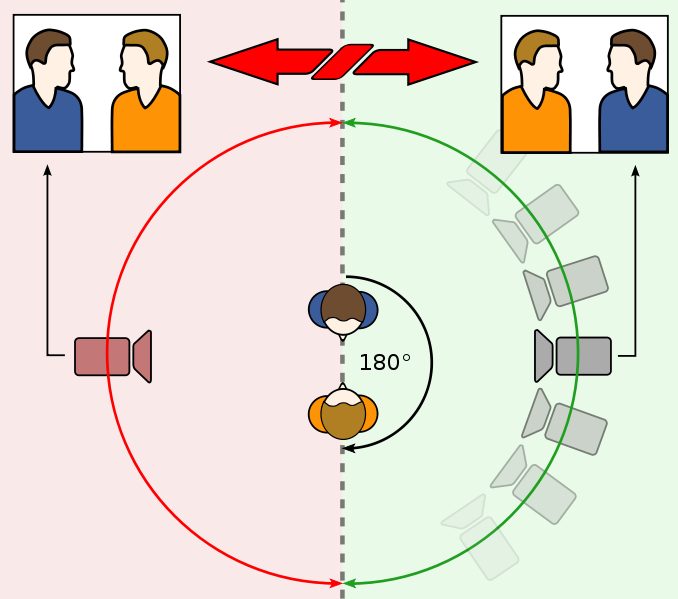
The 180 degree rule is when a character is having a shot taken of them and then the camera is switched to the other character. The 180° rule is a basic film editing guideline that states that two characters (or other elements) in the same scene should always have the same left/right relationship to each other. If the camera passes over the imaginary axis connecting the two subjects, it is called crossing the line. The new shot, from the opposite side, is known as a reverse angle.
Friday, 14 November 2008
Target Audience and Questionnaire
This project unlike the previous ones does not have a specific target audience, neither does it fit into any particular genre. The only task which I have to achieve is as long as it fits all the required criteria then I should get a decent grade. The film does not have to be made to fit any particular genre. Even though my film will be based in the school college, the only real target audience would be either the students or teachers. But overall it does not have a specific target audience that I just keep to
Questionnaire and Chart of Results

I asked around twenty students what genre they wanted to see and the results are as followed:
Questionnaire and Chart of Results

I asked around twenty students what genre they wanted to see and the results are as followed:
- Action- 3 people
- Comedy- 7 people
- General- 13 people
- Fantasy- None
Subscribe to:
Comments (Atom)

